


Views: 0 Author: Site Editor Publish Time: 2026-03-04 Origin: Site


In factories, warehouses, hospitals, workshops, and distribution centers, mobility isn’t a “nice-to-have”—it’s a productivity multiplier. Move materials faster, reduce manual lifting, improve workflow, and keep equipment flexible, and you’ll feel the impact immediately. That’s why industrial casters are used everywhere: on trolleys, racks, tool cabinets, workbenches, carts, equipment frames, and even mobile production lines. But here’s the reality we see every day: many caster problems are not caused by poor quality—they’re caused by selecting the wrong type. A cart that’s hard to steer, casters that wobble under load, flat spots, noisy rolling, floor marks, or unsafe drift on ramps—these issues often start with a simple misunderstanding of the basics.
So, what are the two types of casters? In the simplest and most widely accepted classification, casters come in two main types: swivel casters and rigid (fixed) casters. Understanding these two types—and how they behave in real operations—helps you build carts and equipment that move smoothly, stop safely, and last longer.
From our perspective at Century Langyi casters & trolleys Mfg Co., Ltd., the best caster choice is never about one “best model.” It’s about matching movement pattern + load + floor condition + safety needs. In this guide, we’ll explain the two types of casters clearly, show where each type performs best, and share practical selection tips that reduce risk and improve daily handling efficiency.
Before we go further, it helps to define what we mean by casters. Industrial casters are wheel assemblies designed to mount under equipment or carts to allow controlled movement. A caster typically includes:
a wheel (the rolling part),
a fork/housing (holds the wheel),
a mounting method (plate, stem, bolt hole),
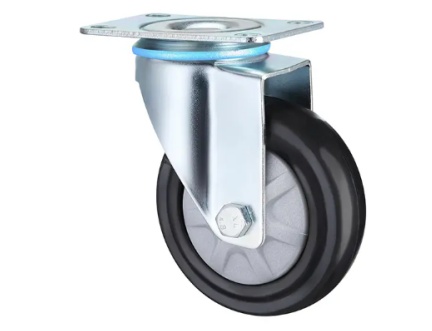
and in the case of swivel casters, a rotating swivel head.
Casters are built for short-distance maneuvering, not road travel. They focus on steerability, floor protection, and safe control in industrial environments.
A swivel caster has a swivel bearing that allows the caster to rotate 360°, so the equipment can change direction easily.
What it’s best at
tight turning spaces
frequent direction changes
maneuvering around obstacles
improving steering flexibility for operators
Real-world examples
mobile tool cabinets
medical carts
small trolleys in narrow aisles
workstations that need frequent repositioning
Trade-off
Swivel casters are more maneuverable, but under high load or fast pushing, they can be less directionally stable than fixed casters unless the design is optimized (bearing quality, kingpin design, wheel material, and braking system).
A rigid (fixed) caster does not rotate. The wheel only rolls forward and backward in one direction, keeping movement straight.
What it’s best at
straight-line travel
stable tracking under heavy loads
long corridors or repeated routes
reducing “wander” when pushing heavy carts
Real-world examples
material handling carts moving along fixed routes
heavy racks and production carts
towing applications inside factories
long aisle warehouse movement
Trade-off
Fixed casters are stable, but turning requires more space. To change direction, operators typically pivot the cart using swivel casters paired with fixed casters (more on that below).
In many industrial carts, the best solution is not “all swivel” or “all rigid,” but a combination:
2 swivel casters + 2 rigid casters
Why this works:
swivel casters provide steering control
rigid casters provide straight-line stability
operators can pivot the cart with less effort
the cart tracks more predictably under load
This configuration is widely used on warehouse trolleys and industrial carts because it balances maneuverability and stability.
Some carts use 4 swivel casters—especially when space is tight.
Choose 4 swivel casters when:
the cart must move sideways into position
aisles are narrow and turning radius is limited
the cart is repositioned frequently in short distances
operators need maximum flexibility
But there’s a safety note: with 4 swivel casters, the cart can drift more easily on slopes unless you use proper brakes and load control.
Feature | Swivel Casters | Rigid (Fixed) Casters |
Steering | excellent, 360° rotation | limited, straight only |
Best movement pattern | frequent turns, tight spaces | straight routes, long travel |
Stability under heavy pushing | depends on design + brakes | high stability |
Turning radius | small | larger |
Typical industrial setup | paired with rigid casters | paired with swivel casters |
Once you understand the two types of casters—swivel and rigid (fixed)—selection becomes much easier. The next step is making sure the caster you choose matches real operating conditions. In our experience, most “caster failures” are not about the wheel breaking; they’re about wrong load assumptions, wrong wheel material for the floor, or missing safety features. Below are the six practical factors we recommend buyers check before ordering industrial casters .
Many buyers only look at the advertised load rating, but industrial casters face different load situations:
Static load: when the cart is parked and weight is resting on the casters
Dynamic load: when the cart is moving and load shifts during pushing/pulling
Impact load: when rolling over seams, thresholds, expansion joints, or uneven floors
A safer approach is to build a margin—especially for heavy equipment, uneven floors, and carts that are pushed fast or frequently. If a cart carries 4 casters, don’t assume all 4 share the load equally in real life; turns and bumps can temporarily overload one corner.
Floor surfaces change everything: smooth epoxy, concrete with seams, tiles, and ramps/thresholds each create different vibration and resistance. A wheel that rolls perfectly on epoxy may chatter loudly on tile grout lines. Matching wheel material + wheel diameter to the floor reduces vibration, protects the surface, and lowers pushing effort.
In general, bigger wheels:
roll over obstacles more easily
reduce pushing effort
improve stability on uneven floors
Wider wheels:
distribute load better
may reduce floor pressure (depending on wheel material and hardness)
If your carts frequently cross door tracks or small steps, increasing diameter is often the simplest performance upgrade.
Common materials include:
Polyurethane: a practical balance of durability + floor protection
Rubber: quieter with good grip, but can wear faster
Nylon/PP: low rolling resistance and tough, but can be noisier/harder on floors
Cast iron/steel: heavy-duty for harsh conditions, but not floor-friendly
The right choice depends on noise tolerance, floor protection needs, and load.
Brakes are essential on slopes, ramps, and when parking near workstations. Options include:
Wheel brake (stops rolling)
Swivel lock (stops turning)
Total lock (locks both wheel + swivel)
Choosing the right brake reduces drift and improves safety during loading and unloading.
Industrial casters are commonly mounted using:
Top plate
Threaded stem
Grip ring stem
Bolt hole
Mounting must match the equipment design to avoid loosening, vibration, or failure over time. A strong wheel on the wrong mount is still a weak system—so confirm mounting dimensions early.
So, what are the two types of casters? In industrial applications, the foundation starts with swivel casters (for steering) and rigid/fixed casters (for straight-line stability). Once you understand how each type behaves, it becomes much easier to build carts and equipment that roll smoothly, steer predictably, and stay safe under real working loads. The most reliable setups usually combine both types—because industrial movement needs both flexibility and control.
At Century Langyi casters & trolleys Mfg Co., Ltd., we manufacture and supply industrial casters for a wide range of carts and equipment, helping buyers match caster type, wheel material, load rating, and braking systems to their real use conditions. If you’re selecting casters for trolleys, racks, or mobile equipment, you’re welcome to learn more from Century Langyi casters & trolleys Mfg Co., Ltd. and contact us for product information and selection support.
The two main types are swivel casters (turn 360° for steering) and rigid/fixed casters (roll straight for stability).
Rigid casters usually provide better straight-line stability under heavy loads, but many heavy-duty carts use a combination of rigid and swivel casters.
This setup balances maneuverability and stability, making carts easier to steer while keeping straight tracking under load.
For many workplaces, a total lock brake is ideal because it locks both the wheel and swivel, improving safety when parked.


