


Views: 0 Author: Site Editor Publish Time: 2026-03-18 Origin: Site


Industrial mobility depends heavily on the performance and durability of Industrial Casters. In demanding environments such as manufacturing plants, logistics centers, heavy equipment workshops, and material handling systems, the choice of caster construction directly affects safety, lifespan, maintenance cost, and operational efficiency. One of the most common questions buyers ask when selecting heavy-duty casters is the difference between forged casters and cast casters. While both are widely used across industries, their manufacturing methods, structural strength, cost structure, and application scenarios differ significantly.
At Century Langyi casters & trolleys Mfg Co., Ltd., we regularly support customers who must choose between forged and cast caster designs for new equipment, facility upgrades, or replacement programs. Understanding how each construction method performs under load, shock, and continuous movement helps buyers make practical decisions rather than relying on generic product descriptions. In this article, we explain how forged and cast casters are made, how they behave in real working conditions, and how to determine which option is more suitable for your application.
Before comparing forged and cast casters, it is important to understand what parts of a caster are affected by the manufacturing method. Industrial casters consist of several structural elements, including the mounting plate, fork frame, swivel raceway, axle support, and wheel assembly. The fork and load-bearing structural components are where forging or casting processes are most commonly applied.
The manufacturing method determines grain structure, density, impact resistance, and overall strength of these structural parts. This is why two casters with identical load ratings on paper may perform differently in real environments such as shock loading, uneven floors, or continuous heavy use.
Forged casters are produced using a forging process in which steel is heated and shaped under high pressure. Instead of pouring molten metal into a mold, the material is mechanically compressed to form the caster components.
This process aligns the internal grain structure of the metal, creating higher strength and improved fatigue resistance. Forged caster frames are typically denser and more resistant to deformation under heavy loads.
Forged industrial casters are known for structural integrity. The compressed grain structure allows them to withstand repeated shock loads without cracking. This makes them suitable for harsh industrial environments where equipment is moved frequently or encounters uneven surfaces.
Forged casters also perform well under dynamic loading conditions. When loads shift suddenly, forged structures distribute stress more effectively, reducing the risk of frame failure.
Another advantage is long service life. Because forged components resist micro-fractures, they maintain performance over extended cycles.
Cast casters are produced by pouring molten metal into molds to form the structural components. Casting allows manufacturers to create complex shapes more easily and efficiently compared to forging.
The casting process is widely used across industrial caster production because it offers flexibility in design and cost efficiency, especially for medium-duty and standard heavy-duty applications.
Cast casters offer consistent dimensional accuracy and allow more design variations. This makes them suitable for applications requiring specific structural geometry, integrated reinforcements, or specialized mounting configurations.
Because casting does not compress the metal grain structure in the same way forging does, cast components may have slightly lower impact resistance compared with forged alternatives. However, modern casting techniques produce highly reliable casters for many industrial applications.
Cast casters are often selected when load conditions are predictable and extreme shock is not a primary concern.
The fundamental difference lies in how the metal structure is formed.
Factor | Forged Casters | Cast Casters |
Manufacturing process | Metal compressed under pressure | Molten metal poured into mold |
Grain structure | Aligned and dense | Random structure |
Impact resistance | Very high | Moderate to high |
Design flexibility | Moderate | High |
Cost | Higher | More economical |
Typical use | Extreme duty environments | Standard industrial applications |
The grain structure difference is the most important technical distinction. Forging strengthens the metal internally, while casting focuses on shape formation.
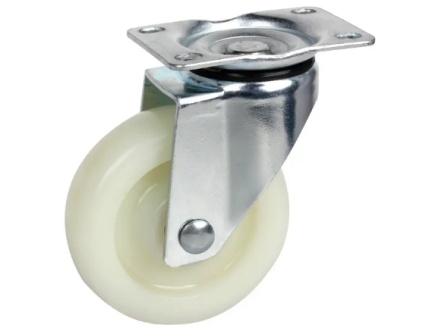
In real industrial environments, the difference between forged and cast casters becomes most visible under dynamic loading, shock, and continuous operation.
Forged casters perform exceptionally well in steel plants, heavy machinery movement, aerospace tooling transport, and large equipment handling. These scenarios involve sudden force changes, high loads, and long operational cycles.
Cast casters are commonly used in warehouses, assembly lines, carts, hospital equipment, and logistics platforms where loads remain relatively stable and predictable. They provide reliable performance without the additional cost of forging.
For many customers, the decision is not about which option is better overall, but which option matches the working conditions.
Structural durability is one of the primary reasons buyers consider forged casters.
Forged industrial casters resist deformation when exposed to repeated shock. This is particularly important when carts move across thresholds, ramps, or uneven concrete floors. Over time, cast frames may show signs of fatigue earlier in these environments.
However, this does not mean cast casters are weak. High-quality cast casters can handle substantial loads and provide long service life when used within design parameters. The key factor is matching caster construction to actual stress conditions rather than maximum load ratings alone.
Cost is another important factor influencing selection.
Forged casters typically require more manufacturing steps, specialized equipment, and higher material control, resulting in higher pricing. For applications requiring maximum durability, this cost is often justified by reduced replacement frequency and downtime.
Cast casters offer cost efficiency and scalability. They are widely used in large quantity equipment programs where performance requirements are demanding but not extreme.
Many customers choose a hybrid strategy, using forged casters for critical equipment and cast casters for standard mobility solutions.
Understanding application scenarios helps clarify the difference.
Forged industrial casters are preferred for:
Heavy machinery transport
Steel and foundry environments
Aerospace tooling movement
Large molds and dies
High-impact material handling
Cast industrial casters are commonly used for:
Warehouse carts
Platform trolleys
Assembly line equipment
Institutional carts
General logistics handling
Selecting the correct caster construction improves equipment reliability and reduces lifecycle cost.
Casting provides greater flexibility when designing complex shapes, integrated ribs, or custom mounting structures. This makes cast casters attractive for OEM equipment manufacturers requiring specific geometry.
Forging, while more limited in shape flexibility, excels in structural reliability. Engineers often prioritize forging when safety margins are critical.
At Century Langyi casters & trolleys Mfg Co., Ltd., we work with customers early in the design stage to evaluate load distribution, movement patterns, and environmental conditions before recommending forged or cast solutions.
Maintenance requirements also differ slightly.
Forged casters typically require less structural maintenance because frame fatigue occurs more slowly. They are often used in long-term heavy equipment programs where replacement cycles are extended.
Cast casters may require more frequent inspection in high-impact environments but perform reliably in controlled settings. Proper wheel selection, bearing choice, and floor conditions often influence maintenance frequency more than the manufacturing method itself.
Lifecycle cost analysis should consider replacement frequency, downtime risk, and safety requirements rather than purchase price alone.
When deciding between forged and cast industrial casters, buyers should evaluate:
Load type (static vs dynamic)
Shock exposure
Movement frequency
Floor conditions
Safety requirements
Budget constraints
If equipment experiences repeated impact, forged casters usually provide better long-term value. If loads are stable and movement is predictable, cast casters offer practical performance with lower cost.
The difference between forged and cast casters ultimately comes down to structural strength, impact resistance, design flexibility, and application requirements. Forged industrial casters deliver superior durability in extreme environments, while cast casters provide cost-effective performance for standard material handling applications. Understanding these differences allows buyers to match caster construction with real operating conditions rather than relying solely on load ratings.
At Century Langyi casters & trolleys Mfg Co., Ltd., we help customers evaluate movement patterns, load characteristics, and environmental factors to recommend the most suitable caster solutions. Whether your project requires heavy-duty forged structures or reliable cast designs for large-scale equipment programs, our engineering team can support your selection process. For more information about forged and cast industrial mobility solutions, you can contact Century Langyi casters & trolleys Mfg Co., Ltd. to explore available options and discuss your application requirements.
The main difference is the manufacturing process. Forged casters use compressed metal for higher strength, while cast casters are formed by pouring molten metal into molds.
Not always. Forged casters are better for high-impact and extreme duty environments, while cast casters are suitable for many standard industrial applications.
In high-stress environments, forged casters often provide longer service life due to improved structural durability.
Cast casters are a good choice when loads are stable, movement is predictable, and cost efficiency is an important factor.


