


Views: 0 Author: Site Editor Publish Time: 2026-10-15 Origin: Site


Procuring material handling equipment in bulk represents a massive capital investment for any growing operation. You need dependable tools. They must perform reliably under heavy stress day after day. Unfortunately, poor equipment selection directly leads to severe ergonomic injuries among staff. It also causes premature equipment failure and significantly disrupts daily warehouse workflows. A successful bulk purchase must carefully balance the initial upfront unit cost with long-lasting durability. You must achieve strict operational safety standards while maximizing overall value. This article provides procurement teams and warehouse managers with an objective, technical framework. We will guide you through auditing manufacturers effectively and avoiding common purchasing pitfalls. You will learn exactly how to specify the right equipment tailored for your specific industrial environment. Making informed choices now saves thousands of dollars in replacement costs later.
Clarify exact terminology (trolley vs. truck vs. dolly) before issuing an RFQ to ensure accurate vendor quotes.
Evaluate load capacities based on dynamic (moving) weight, not just static (stationary) weight, to prevent structural failure.
Prioritize caster quality over deck material; wheels dictate 80% of a trolley's ergonomic performance and lifespan.
Vet manufacturers on production scalability, ISO compliance, and ability to provide custom engineering for specific industrial tasks.
Manufacturers often use overlapping terminology when describing moving equipment. Defining your exact needs upfront prevents costly quoting errors during the procurement process. You must know exactly what you are asking for before sending a Request for Quote (RFQ). Understanding platform trolley vs platform truck distinctions is your crucial first step.
Trolleys generally feature lighter-duty, single-handle designs. They work perfectly for retail settings. You will also see them in light commercial spaces or standard warehouse picking aisles. They maneuver easily around tight corners. However, trucks boast a heavy-duty, reinforced chassis. Factories often build them from thick steel for high-capacity industrial environments. These robust units endure punishing conditions. They sometimes feature towing eyes designed for tugger trains in massive automotive plants.
Do not confuse these items with a platform dolly. A dolly serves as a handle-less, low-profile alternative. You should use it strictly for moving bulky, static loads over very short distances. Furniture movers and appliance installers rely heavily on them. They lack the ergonomic handles needed for continuous warehouse routing.
Meanwhile, terms like platform cart and material handling trolley act as broad industry catch-alls. Buyers use them interchangeably. When speaking to suppliers, you require strict specification of your needs. Always clarify your required deck size. Specify your handle configuration clearly. Tell the vendor if you need fixed handles or folding mechanisms. Providing accurate load ratings prevents the vendor from quoting under-engineered equipment.
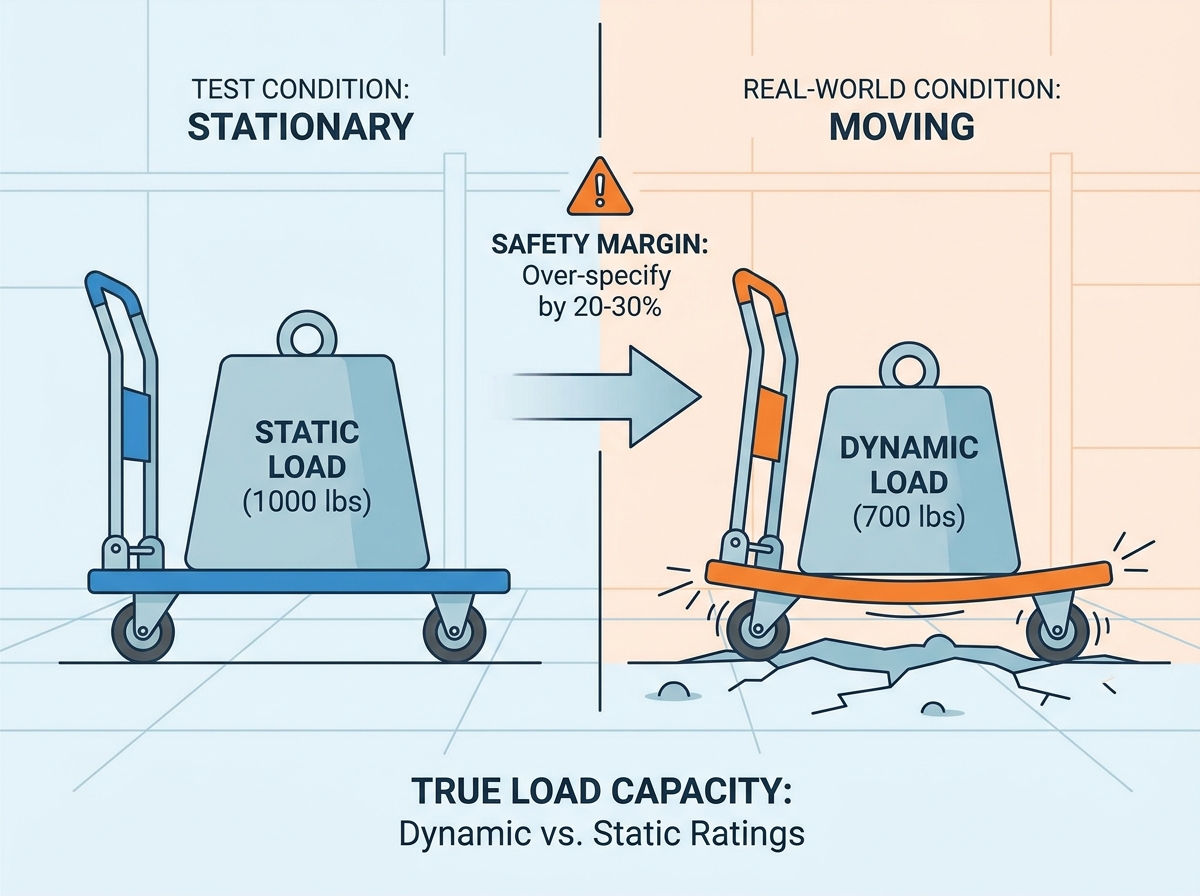
Manufacturers frequently advertise maximum load capacities based solely on static tests. They place heavy weights on a stationary deck and measure deflection. Relying on stationary weight ratings for operational use often leads to severe chassis warping. You evaluate equipment based on how it moves, not how it sits in a laboratory.
Demand dynamic load testing data from every potential supplier. Dynamic capacity reveals how the equipment handles weight while in motion. A cart rated for 1,000 lbs statically may only safely maneuver 700 lbs dynamically. Uneven warehouse floors create massive stress on the frame. Rolling over expansion joints sends shockwaves through the chassis. Moving over dock plates punishes the wheel brackets. Ignoring this implementation reality guarantees early equipment failure.
We advise buyers to over-specify load capacity by at least 20 to 30 percent. This critical safety margin accounts for load dropping. Workers often drop heavy boxes directly onto the deck. Engineers call this shock loading. Shock loading instantly multiplies the effective weight of the object. An extra safety margin also protects the frame against uneven weight distribution. Rushed packing often leaves all the weight resting over just one wheel. Over-engineering your capacity rating prevents catastrophic structural failures.
Cheap casters remain the number one point of failure in bulk orders. Evaluating wheel quality provides a massive hidden return on investment. Wheels dictate the vast majority of lifecycle performance. They govern 80 percent of a unit's ergonomic usability. If the wheels fail, the entire unit becomes useless.
Wheel material selection must match your specific facility floors perfectly. Polyurethane or nylon wheels work best for smooth concrete surfaces. They offer very low rolling resistance for moving heavy loads. This reduces the initial push force required from your workers. Conversely, solid rubber or pneumatic wheels become necessary for outdoor use. They excel on uneven surfaces like gravel or asphalt. You also need them for delicate flooring found in hospitals and hotels. They absorb shocks and prevent floor scratching.
You must specify precision sealed ball bearings over standard roller bearings. Standard bearings collect dust, shrink wrap, and debris quickly. Sealed ball bearings lock out factory dirt entirely. They drastically reduce push and pull strain on workers. This proactive choice actively mitigates workplace ergonomic injuries. It keeps your operation aligned with strict occupational safety guidelines.
Consider your wheel configuration carefully before ordering. The standard setup includes two rigid front wheels and two swivel rear wheels. This configuration tracks straight down long aisles easily. However, tight aisles might require specialized setups. A diamond center mounting configuration uses larger center wheels. This setup allows for a true zero-turn radius in narrow warehouse rows.
Caster Material Comparison Guide
Wheel Material | Best Suited Environment | Primary Advantage | Common Drawback |
|---|---|---|---|
Polyurethane | Smooth warehouse concrete | High load capacity, easy rolling | Can struggle to roll over floor debris |
Solid Rubber | Uneven surfaces, outdoor loading | Shock absorption, quiet operation | Higher initial push resistance |
Pneumatic | Rough terrain, gravel yards | Maximum cushioning for fragile goods | Requires routine air pressure maintenance |
Nylon | Heavy manufacturing, food prep | Highly chemical and impact resistant | Loud and noisy on hard floors |
Match your chassis material directly to your specific operational environment. This features-to-outcomes approach helps you avoid rapid structural degradation. Different industries demand distinct structural materials. Buying the wrong deck material accelerates equipment death.
Steel remains best for heavy manufacturing and industrial fabrication shops. It provides exceptional impact resistance for brutal daily tasks. Workers can drop heavy engine blocks on it safely. However, steel carries a notable risk. It becomes highly susceptible to rust in damp environments. If a forklift scratches the powder-coated finish, moisture attacks the exposed metal. Rust weakens the structural integrity rapidly.
Aluminum options command a premium cost upfront. Fortunately, they provide an incredible return on investment. They are incredibly lightweight and naturally corrosion-resistant. Aluminum never rusts. It proves ideal for sterile cleanrooms. Delivery truck drivers also prefer aluminum. They lift these units in and out of trucks repeatedly. Cutting frame weight saves their backs from daily strain.
Structural plastics and heavy-duty polymers offer unique industrial advantages. Manufacturers often mold them from high-density polyethylene (HDPE). They are completely non-conductive and rust-proof. You can sanitize them easily using harsh chemical washdowns. We highly recommend them for food processing plants. Pharmaceutical facilities rely on them strictly. They also serve perfectly for light-duty commercial use where daily hygiene takes absolute priority.
You must assess the factory’s true capabilities before signing any bulk contracts. Start by verifying their Monthly Production Capacity (MPC). You need a vendor capable of handling your volume seamlessly. Evaluate their supply chain redundancy carefully. Ask where they source crucial raw materials like sheet steel and raw casters. Supply chain redundancy guarantees they can ensure timely bulk delivery without unexpected delays.
Always question their engineering and customization capabilities. Off-the-shelf products rarely fit specialized workflows perfectly. Ask if the manufacturer can modify deck dimensions. You might need decks sized to fit your exact standard tote bins. See if they can add specific braking systems. Deadman brakes enhance safety on inclined ramps significantly. You might also need them to install custom racking directly on the base to hold loose components.
Verify their factory compliance and certifications rigorously. Never take their word on quality control or safety limits. A professional manufacturer happily provides transparent documentation. Look for these vital verification markers:
Quality Management Systems: Look for verifiable ISO 9001 certification to ensure consistent manufacturing processes.
Environmental Responsibility: Check for ISO 14001 certification if your corporate procurement policy requires green sourcing.
Independent Lab Testing: Request official third-party load test certificates from reputable bodies like SGS or TUV.
Material Traceability: Ask for mill certificates verifying the grade of steel or aluminum used in the chassis.
Look far beyond the initial unit price when comparing vendor bids. The cheapest cart often costs the most over a five-year period. Calculate long-term value by factoring in expected equipment lifespan. Determine the overall maintenance frequency required for each unit. You must also check the regional availability of replacement parts. Finding matching replacement casters locally keeps your fleet operational.
Never place a massive bulk order without rigorously testing a prototype first. Require the manufacturer to provide a physical sample unit. You should run this unit through a grueling two-week operational stress test. Test it exclusively on your actual facility floors. Use your heaviest standard loads. Monitor how the deck deflects under maximum weight. Ask your floor workers for direct feedback on the push resistance and handle height.
Scrutinize the fine print of their warranty terms very closely. Warranty documents often hide expensive realities. Many buyers discover too late that casters count as consumable items. Vendors often exclude wheels entirely from their impressive five-year chassis warranties. Knowing these warranty realities helps you budget for replacement parts accurately. It prevents surprise expenses during your annual maintenance reviews.
Bulk purchasing material handling equipment requires looking far past basic dimensions and cheap unit prices. You must secure tools that protect your workforce and streamline your daily logistics. Evaluating dynamic weights correctly prevents catastrophic structural collapses. Auditing factory standards guarantees you partner with a reliable supplier. Selecting the right wheel materials and bearings dictates the ultimate success of your purchase.
Take specific action before you contact another supplier. Draft a highly comprehensive Request for Proposal (RFP) for your procurement team. Explicitly state your dynamic load requirements within the document. List your exact required caster specifications, including bearing types and tread materials. Clearly outline your facility's environmental conditions, highlighting specific floor types and potential chemical exposures. Approaching manufacturers with exact, uncompromising specifications forces them to provide accurate, comparable, and highly reliable quotes.
A: Most reputable factory-direct manufacturers set their MOQ between 50 and 100 units. The exact number depends heavily on your required customization. Off-the-shelf models often carry lower MOQs, sometimes starting around 20 units. If you need custom deck sizes, unique paint colors, or specialized braking systems, expect suppliers to demand higher minimums. They need higher volumes to justify resetting their production lines.
A: We strongly advise against attempting this upgrade. A dolly fundamentally lacks the reinforced structural mounting points required for a secure handle. Welding or bolting a makeshift handle onto a low-profile frame severely compromises its structural integrity. It introduces extreme safety hazards for the operator. It also instantly voids the manufacturer warranty. You should always buy the correct handled unit upfront.
A: Never trust a static load claim blindly. Request unedited dynamic load testing videos directly from the factory floor. Ask for official laboratory reports from independent, third-party certification bodies like SGS or TUV. Best of all, order a single sample unit. Run it through a localized, heavily weighted stress test in your own facility before committing to a bulk contract.


