


Views: 0 Author: Site Editor Publish Time: 2026-10-15 Origin: Site


Warehouse automation dominates industry discussions today. However, non-motorized manual handling equipment remains the everyday backbone for localized, high-frequency tasks. You cannot run a dynamic facility efficiently without these essential tools.
Misaligned equipment choices often create hidden bottlenecks on the warehouse floor. Selecting the wrong caster types slows down operators. Choosing inadequate deck sizes increases necessary trips. These improper selections directly increase cycle times and worker fatigue. Over time, these small inefficiencies compound into massive productivity losses.
We will explore how to evaluate and select the right equipment for your facility. You will learn actionable strategies to optimize warehouse throughput. We also cover ways to improve ergonomic safety for your workforce. This technical framework provides everything you need to implement smarter manual handling solutions today.
Match the tool to the task: The primary driver of efficiency is choosing correctly between a platform dolly, a platform cart, and a heavy-duty platform truck based on load profile and travel distance.
Casters dictate performance: Rolling resistance and caster configuration directly impact push/pull strain, maneuverability, and worker fatigue.
Ergonomics equal efficiency: Investing in the right handle heights and deck materials reduces repetitive strain injuries and maintains consistent shift productivity.
Standardization reduces friction: Consistent equipment deployment simplifies maintenance, training, and workflow integration.
Many warehouse managers underestimate the impact of manual handling equipment. Poorly matched tools create compounding delays throughout a shift. Operators spend extra time wrestling poorly steered equipment. They take unnecessary steps to compensate for low load capacities.
Improper equipment leads directly to localized congestion. Narrow aisles become blocked when workers use oversized carts. Conversely, undersized decks force operators to make multiple trips. We see these bottlenecks increase warehouse touchpoints unnecessarily. Every extra touchpoint reduces overall operational efficiency.
You must define success criteria beyond the initial purchase price. Effective metrics focus strictly on operational output. Look closely at your reduction in cycle times. Measure your pick-path efficiency before and after equipment upgrades. You should also track the incidence rate of musculoskeletal disorders (MSDs).
The ergonomic threshold plays a massive role in sustained throughput. OSHA and NIOSH provide clear guidelines regarding push and pull force limits. Pushing requires less biomechanical strain than pulling. Operators can sustain higher throughput when push forces remain below 50 pounds. Equipment design dictates these forces entirely. Worn casters or poorly designed handles push operators past safe ergonomic thresholds. Once workers cross this threshold, shift productivity plummets.
Consider the following common bottlenecks caused by improper equipment:
Increased Travel Time: Operators take longer routes to avoid rough flooring they cannot navigate.
Load Instability: Slippery decks cause products to shift, requiring operators to stop and repack.
Physical Exhaustion: High rolling resistance forces workers to expend maximum energy early in their shift.
Aisle Traffic Jams: Inability to turn sharply traps carts in tight picking zones.
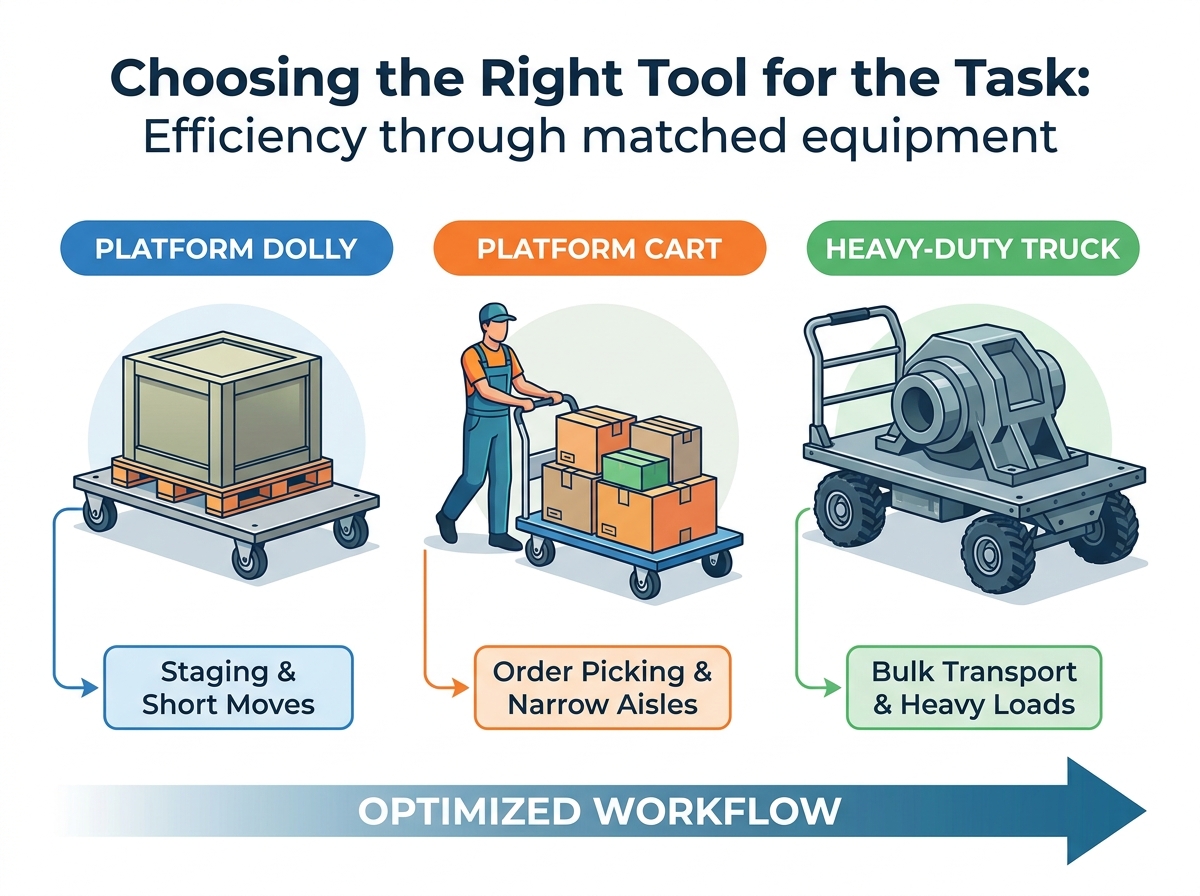
Understanding the platform trolley vs platform truck distinction helps managers equip their teams correctly. You must categorize your solutions based on specific warehouse applications. Each equipment category serves a distinct operational purpose.
We define a platform dolly as a flush deck completely lacking handles. Manufacturers design them strictly for foundational support. They sit low to the ground and usually feature four swivel casters.
These units work best for staging bulky, static loads. You can use them to move large furniture or heavy crates over very short, straight distances. They excel in confined staging areas.
However, they possess severe limitations. They offer a terribly poor ergonomic profile for continuous movement. Operators must bend constantly to push the load itself. They also prove notoriously difficult to steer precisely down long warehouse aisles.
A standard platform cart features a flat deck paired with a single or double push handle. Manufacturers typically rate them for light to medium loads. They bridge the gap between simple dollies and massive industrial trucks.
These carts perform best during order picking. They move boxed goods efficiently across smooth concrete floors. Their handle design allows operators to navigate narrow aisles easily. You will find them indispensable in retail backrooms and e-commerce fulfillment centers.
In most facilities, this remains the most versatile material handling trolley available. It handles daily, high-frequency tasks effortlessly. Operators can load them quickly and push them without excessive physical strain.
Heavy-duty platform trucks feature heavily reinforced decks. Manufacturers build them from solid steel or thick structural plastic. They include high-capacity casters and incredibly robust handle structures. Some models feature dual handles for multi-operator pushing.
You need these trucks for transporting oversized loads. They excel at moving exceptionally heavy or unevenly distributed materials. Operators use them constantly to move bulk inventory from receiving docks to long-term storage areas.
Operations cross the threshold from standard trolleys to trucks due to physical limits. Standard carts experience load deflection under extreme weight. Their decks bow and their casters fail. When you notice frequent caster replacements on standard carts, you must upgrade to a heavy-duty truck.
Equipment Comparison Matrix
Equipment Type | Primary Use Case | Load Capacity Range | Ergonomic Rating |
|---|---|---|---|
Platform Dolly | Static staging, short pushes | Medium to High | Poor (No handles) |
Platform Cart | Order picking, narrow aisles | Light to Medium | Excellent (Upright posture) |
Platform Truck | Bulk transport, heavy freight | Very High | Good (Requires more force) |
You cannot buy equipment based solely on catalog pictures. You must evaluate technical specifications to ensure operational efficiency. The right components transform a simple cart into a high-performance productivity tool.
Casters dictate almost all performance metrics. The material impact changes how the cart interacts with your floors. Polyurethane casters offer an ideal balance. They provide extreme durability while remaining entirely floor-safe. Rubber casters deliver excellent shock absorption. They run quietly but require more physical effort to push. Nylon and steel casters handle the heaviest possible loads. However, they create very high rolling resistance and often damage unprotected floors.
Caster configuration also changes operational dynamics. A standard setup features two swivel casters in the back and two rigid casters in the front. This provides excellent directional control down long aisles. Conversely, a four-swivel configuration allows omnidirectional movement. You need four swivel casters when navigating incredibly tight spaces or staging areas.
Deck material impacts both equipment weight and structural integrity. You must balance the tare weight of the equipment against its maximum load capacity. Wood decks provide good grip and handle impacts well. Steel decks offer unmatched capacity but add significant dead weight. Structural plastic resists corrosion entirely. It offers a lightweight alternative for medium-duty applications.
Slip resistance matters immensely during transit. Smooth steel decks allow plastic totes to slide around. You should look for textured plastic or rubberized mats. Edge lip configurations also prevent load shifting. A small half-inch lip keeps cylindrical items from rolling off the deck during sudden stops.
Handle design directly affects operator fatigue levels. Fixed handles provide maximum structural rigidity. They withstand aggressive pushing and heavy loads. Folding handles offer brilliant space-saving benefits. You can store folding carts easily inside delivery vehicles. However, folding mechanisms introduce weak points over time.
Optimal handle height remains non-negotiable. Handles should sit between the operator's waist and lower chest. This height allows operators to use their core body weight for pushing. If handles sit too low, operators rely solely on upper body and lower back strength. This poor posture leads quickly to serious injuries.
Purchasing great equipment only solves half the problem. You must integrate these tools smoothly into your daily operational workflows. Smart integration multiplies your efficiency gains.
Modern fulfillment relies heavily on zone picking. You can use multi-tier platform carts to supercharge this process. Multi-tier setups allow operators to pick multiple orders simultaneously. They separate different orders into distinct bins on the cart.
This batching strategy reduces total travel time drastically. Operators walk an aisle once and fulfill five orders. The right cart makes this complex sorting process intuitive and physically easy.
Fast-moving facilities rely on aggressive cross-docking. You should deploy heavy-duty platform trucks as temporary mobile staging areas. When freight arrives, workers load it directly onto large trucks.
Instead of placing pallets on the floor, keep the inventory mobile. You minimize the double-handling of incoming freight entirely. Workers can roll the loaded truck straight to the outbound dock when the outbound truck arrives.
Your equipment must physically match your warehouse environment. You must ensure the physical footprint of the cart aligns with current rack spacing. Measure your narrowest aisles before ordering equipment.
Consider the turning radius carefully. A large truck might fit down an aisle but fail to turn the corner. Follow these steps to ensure layout compatibility:
Measure the distance between your tightest racking sections.
Calculate the necessary turning radius for intersecting aisles.
Audit the floor condition for major cracks or expansion joints.
Select caster wheels large enough to bridge any floor gaps safely.
New equipment rollouts often face unforeseen operational friction. You must manage operator behavior and establish strict maintenance protocols. Proper management extends equipment lifespan significantly.
Employee misuse ruins excellent equipment quickly. Workers often grab whatever tool sits closest to them. They might use a simple platform dolly when a controlled cart is clearly needed. This creates immediate safety hazards.
Overloading beyond the rated capacity happens daily. Operators try to save time by piling too much inventory onto a light-duty cart. This bends the deck and shatters the caster bearings. You must enforce weight limits strictly through training and visual cues.
Manual equipment still requires consistent attention. You must establish a preventative maintenance schedule. Ignoring maintenance destroys operational efficiency.
Casters wear out over time. They collect shrink wrap, dust, and debris from the floor. This buildup drastically increases rolling resistance. Maintenance teams must clean and lubricate caster bearings regularly. A clean caster requires half the push force of a dirty one.
Warehouse safety depends on operator training. You must train staff constantly on the "push, don't pull" principle. Pushing utilizes strong leg muscles and protects the fragile lower back. Pulling twists the spine dangerously.
Establish clear line-of-sight rules for loaded platform trucks. Operators must never stack inventory higher than their eye level. If a load requires high stacking, two operators must handle the transport. One pushes while the other spots the blind corners.
Improving warehouse efficiency requires deliberate, technical equipment choices. You must master the shortlisting logic to succeed. First, assess your typical load weight. Next, determine the average travel distance. Then, select the correct equipment category. Finally, specify the exact casters required for your flooring.
We advise decision-makers to audit their current manual handling routes immediately. Identify where workers struggle with high push forces. Test a specific material handling trolley configuration in a limited zone first. Gather operator feedback before committing to a facility-wide rollout. Small, calculated equipment upgrades deliver massive operational improvements.
A: The main difference lies in load capacity and structural reinforcement. Platform trolleys are designed for lighter loads, featuring standard decks and casters ideal for daily order picking. Platform trucks use reinforced materials like heavy steel and high-capacity casters. They are built specifically for transporting oversized, bulk freight safely across the facility.
A: No, you should avoid using them for order picking. They lack push handles, creating severe ergonomic drawbacks. Operators must bend constantly to guide the load. This awkward posture leads quickly to fatigue and lower back injuries during continuous movement.
A: You must balance load capacity, floor protection, and rolling resistance. Use polyurethane for heavy loads on smooth concrete; it protects floors while rolling easily. Choose rubber for rough surfaces to absorb shock, though it requires more push force. Avoid steel wheels unless moving extreme weights, as they damage floors.
A: A high-quality unit typically lasts five to ten years. However, this lifespan depends heavily on proper usage. Strict adherence to weight limits, daily mileage, and routine caster maintenance drastically extend longevity. Neglecting caster lubrication or repeatedly overloading the deck will destroy the cart prematurely.


