


Views: 0 Author: Site Editor Publish Time: 2026-07-07 Origin: Site


Unreliable mobility components compromise patient comfort through excessive noise and vibrations. Subpar wheels also risk expensive medical equipment damage during everyday transport. Additionally, these poorly specified parts increase physical strain on healthcare staff every single shift. Selecting proper clinical mobility components requires balancing low starting resistance against absolute stationary stability. Facilities must also adhere to strict infection control and sanitation protocols. This guide equips procurement teams and equipment engineers with an evidence-based framework. We aim to help you evaluate, specify, and source hospital-grade mobility solutions effectively. You will learn exactly how to match tread materials to flooring types. We also explore the mechanics behind advanced locking systems and ergonomic designs. Finally, you will discover essential evaluation metrics to prevent premature equipment failure and ensure clinical efficiency.
Material Selection: Thermoplastic Elastomer (TPE) combined with precision sealed bearings is the industry standard for minimizing decibel output during transport.
Design Superiority: Twin Wheels Medical Casters distribute loads more efficiently, offering a tighter swivel radius and lower turning resistance in confined clinical spaces.
Safety Imperatives: Advanced braking mechanisms, particularly Central Locking Systems, are mandatory for high-risk applications like hospital beds and surgical carts.
Lifecycle Reality: Total cost of ownership depends heavily on a caster’s resistance to harsh hospital cleaning chemicals and hair/debris entanglement.
Healthcare engineers face a constant core conflict between effortless mobility and uncompromising safety. Equipment must move smoothly to prevent delays during emergencies. However, once positioned, this same equipment requires total lock stability. Achieving this balance demands precise engineering. Low rolling resistance allows quick transport across long corridors. Total lock stability ensures heavy diagnostic machines remain perfectly still during patient procedures.
Ergonomic baselines help facilities measure success accurately. We evaluate these components based on specific push and pull force requirements. Lower starting resistance directly reduces daily staff fatigue. Nurses frequently maneuver heavy beds and carts during twelve-hour shifts. Excessive rolling resistance strains their shoulders and lower backs. Facilities must prioritize designs requiring minimal human exertion.
Sanitation protocols highlight why standard industrial Casters fail completely in healthcare settings. Industrial models lack critical anti-static properties required near sensitive electronics. Standard wheels also degrade quickly under frequent chemical washdowns. Hospital environments demand materials capable of resisting aggressive sterilization routines. Clinical wheels must shed debris, resist corrosion, and maintain absolute hygiene.
Acoustic performance heavily influences patient recovery environments. Facilities must eliminate excessive noise to promote restful healing wards. Evaluating tread materials is the first step toward vibration dampening. Thermoplastic Elastomer (TPE) significantly outperforms standard rubber or polyurethane here. TPE absorbs floor shocks quietly. Precision ball bearings play an equally vital role. They eliminate axle chatter and ensure silent rotation over hard flooring surfaces.
Load capacity calculations determine structural integrity and safety. Engineers differentiate carefully between static weight and dynamic load. Static weight refers strictly to stationary equipment mass. Dynamic load accounts for severe impact forces occurring during active transport. When calculating safe working loads, follow a strict industry rule of thumb. Divide the total equipment weight by three. This formula safely accounts for uneven floors or elevator thresholds.
Facility matching ensures components suit specific operational environments. Hospitals and specialty clinics possess very different mobility needs. Hospital applications focus heavily on high load capacities. They require central locking systems and withstand continuous chemical sterilization. Conversely, clinics and imaging centers prioritize compact footprints. MRI rooms absolutely require specialized non-magnetic Medical Casters. Aesthetic integration also matters deeply in these outpatient settings.
Tread Material | Acoustic Rating | Chemical Resistance | Ideal Healthcare Application |
|---|---|---|---|
Thermoplastic Elastomer (TPE) | Excellent | High | Patient beds, recovery wards |
Polyurethane (PU) | Moderate | Very High | Utility carts, heavy-duty transport |
Standard Rubber | Good | Low | General clinic use (dry areas) |
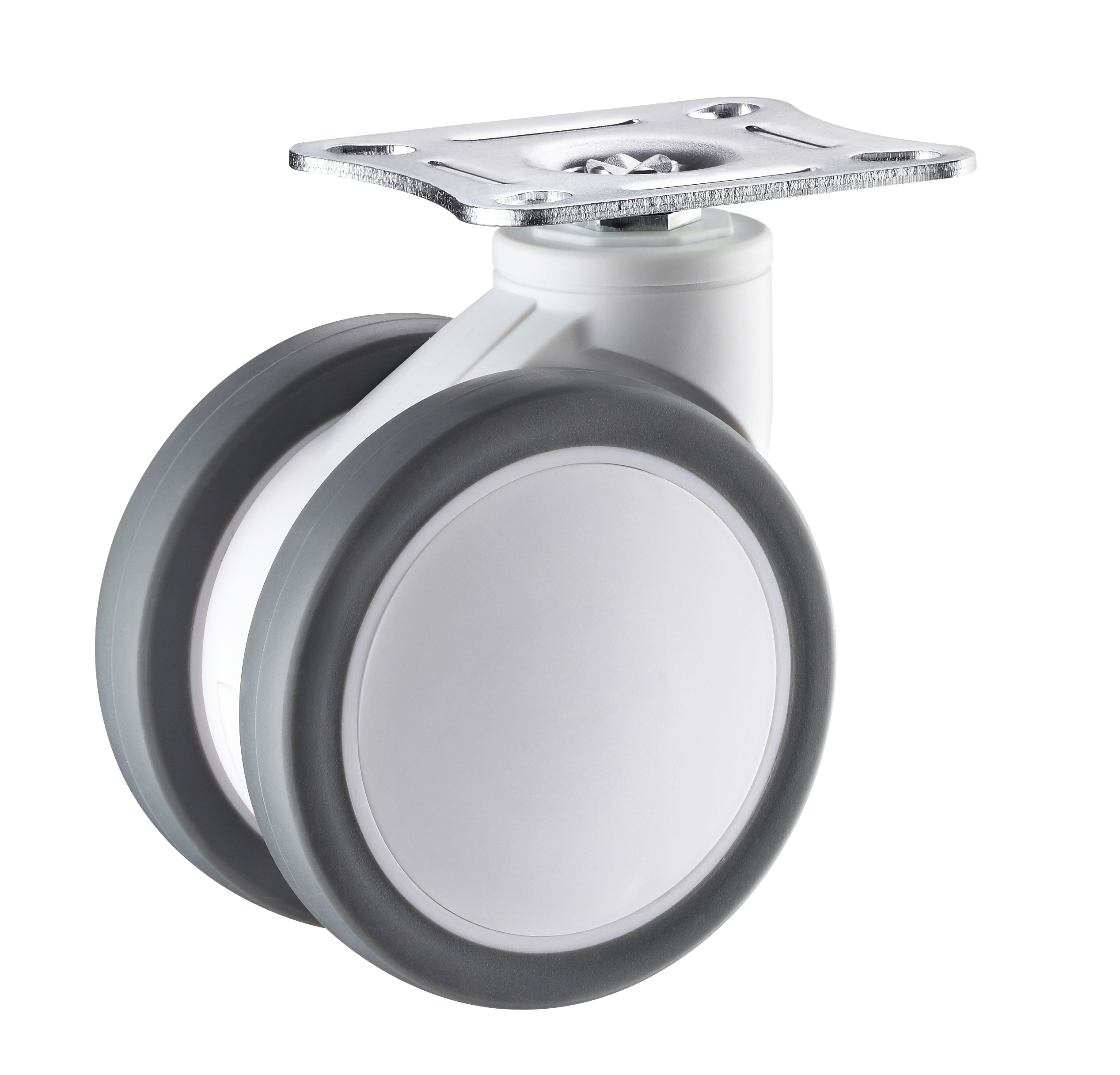
Structural mechanics explain the rising popularity of dual-wheel configurations. Dual wheels increase the total floor contact area dramatically. They achieve this without increasing the overall wheel diameter. This specific design lowers the equipment's center of gravity. A lower center of gravity improves overall tipping resistance. Consequently, taller medical devices gain superior structural stability during fast transit.
Maneuverability in tight clinical spaces dictates daily operational efficiency. You must analyze the reduced scrub radius of Twin Wheels Medical Casters carefully. A smaller scrub radius means the wheel pivots easier on its vertical axis. Therefore, they require significantly less force to change direction from a complete standstill. Nurses navigating crowded trauma bays appreciate this effortless steering capability.
Application fit determines which style best serves your facility. We highly recommend twin wheels for lightweight diagnostic carts. They also suit IV poles and vital sign monitors perfectly. These devices move frequently within confined patient rooms. Alternatively, evaluate single wheels for straight-line transport tasks. Single wheel designs handle heavy-duty material handling along extensive hospital corridors more efficiently.
Central locking systems represent essential architecture for modern hospital beds. These mechanisms allow rapid, secure immobilization during emergencies. Hex or round cam mechanisms reside inside the wheel housing. These cams engage all four corners simultaneously via a single foot pedal. Nurses save precious seconds by locking the entire bed instantly. This single-pedal action prevents dangerous bed shifting during critical patient transfers.
Total lock mechanisms offer robust security for standalone clinical devices. These advanced systems engage two separate components simultaneously. Pressing the pedal stops the wheel rotation completely. Simultaneously, the mechanism locks the swivel fork securely in place. This dual-action prevents any unwanted shifting or pivoting. Total lock designs prove mandatory for surgical tables and delicate diagnostic stations.
Directional locks solve steering challenges over long distances. Swivel designs excel in tight rooms but struggle in straight corridors. Directional locks convert pivoting assemblies into rigid, straight-line rollers. Engaging this lock improves long-corridor tracking significantly. Caregivers exert far less steering effort when pushing heavy carts. This feature reduces wrist strain during cross-facility equipment transport routines.
The debris entanglement risk plagues many healthcare facilities. Floor hair, surgical sutures, and dust constantly threaten mobility hardware. These fibers wrap tightly around exposed axles over time. Eventually, they penetrate the housing and cause premature bearing failure. Integrated thread guards provide a simple, necessary defense. These protective shields block debris from entering the sensitive internal wheel mechanics.
Chemical degradation ruins unprotected treads very quickly. Hospital cleaning protocols utilize highly aggressive solutions daily. You must assess wheel tread resilience against quaternary ammonium compounds. Bleach-based hospital disinfectants also break down inferior rubber materials rapidly. Specifying chemically resistant polymers prevents premature tread cracking. Proper material selection ensures the wheel remains smooth and hygienic over time.
Floor compatibility often goes overlooked during procurement cycles. Hard treads easily damage resilient hospital flooring types. Linoleum and Vinyl Composition Tile (VCT) require softer wheel compounds. You must match the tread durometer directly to your specific floor type. Soft TPE wheels protect expensive flooring from scratches and gouges. This careful matching prevents costly facility maintenance repairs down the line.
Developing a structured procurement process prevents costly specification errors. Buyers should follow a logical progression when selecting mobility hardware. This step-by-step decision tree simplifies complex engineering choices.
Define the maximum dynamic load by dividing total equipment weight by three.
Identify environmental constraints such as MRI magnetic restrictions or frequent chemical exposure.
Select the precise locking requirement needed, choosing between central, total, or directional locks.
Determine the correct form factor, deciding between stem or plate mounts and twin or single wheels.
Prototyping and testing validate your theoretical choices in real-world conditions. Procurement teams should always demand physical sample sets first. Conduct an in-facility push/pull ergonomic audit. Perform a rigorous noise evaluation in an actual patient corridor. Never commit to bulk vendor contracts without this physical validation. Testing prevents ordering hundreds of incompatible or noisy mobility components.
Specifying mobility hardware is never a simple commodity purchase. It represents a critical ergonomic and patient-care decision. Proper wheel selection minimizes hospital noise and protects expensive flooring. It also reduces caregiver fatigue through optimized starting resistance. Balancing load capacity, chemical resistance, and advanced braking ensures long-term operational success.
We encourage buyers to consult directly with application engineers. Request detailed specification sheets to confirm dynamic load ratings. Always ask for product samples to validate acoustic claims within your own facility corridors. Taking these proactive steps guarantees you source the safest, quietest, and most reliable mobility solutions for your healthcare environment.
A: Medical variants prioritize strict noise reduction and floor protection. They also feature crucial anti-static properties and superior cleanability. Standard industrial models focus primarily on raw load capacity and often rust or degrade when exposed to aggressive hospital disinfectants.
A: They offer a much lower profile and better weight distribution. This dual-wheel design provides a significantly tighter turning radius. They require less physical effort to maneuver, making them ideal for small, crowded patient exam rooms.
A: It is a mechanical linkage inside the frame. It allows a caregiver to use a single foot pedal to simultaneously lock the rotation and swivel of multiple wheels. This ensures instant, fail-safe stability during critical patient transfers.
A: Specify sealed precision bearings and integrated thread guards during the initial purchase. Furthermore, avoid using harsh, inappropriate solvents during routine cleaning. Incorrect chemicals strip away internal factory lubrication, leading directly to friction and noise.


