


Views: 0 Author: Site Editor Publish Time: 2026-10-15 Origin: Site


Purchasing the wrong material handling equipment carries a steep, hidden price for any operation. You risk severe bottlenecks in daily warehouse throughput immediately. Worse, you face increased worker compensation claims due to preventable ergonomic strain. Operators push heavy loads daily. They suffer quickly when equipment fights against them.
Terminology across the material handling industry remains notoriously inconsistent today. Manufacturers frequently swap the words "cart," "trolley," and "truck" in their catalogs. This terminology overlap confuses buyers constantly. Operations managers must often guess which unit truly meets their specific payload requirements. They struggle to match products to unique environmental demands.
Finding the right fit requires looking strictly past arbitrary product names. You must evaluate baseline specifications carefully before making a choice. Focus heavily on deck materials and caster configurations. Scrutinize handle ergonomics and true dynamic load capacities. This guide will help you navigate these specifications clearly.
Platform Trolleys: Best for commercial and light-industrial environments; prioritize maneuverability and space-saving designs (often featuring folding handles).
Platform Trucks: Built for heavy-duty, industrial payloads; feature reinforced decks (steel/hardwood) and larger, impact-resistant casters.
Platform Dollies: Handle-less designs ideal for oversized, bulky loads that extend beyond the deck footprint; require careful manual handling.
Decision Driver: Your choice should be dictated by floor surface, maximum load weight, aisle width, and operator ergonomic safety limits.
Every warehouse relies entirely on seamless material movement. Selecting your equipment stands out as a critical operations decision. It goes far beyond a simple procurement checklist for buyers. The wrong choice directly hurts your daily throughput metrics. It increases operator fatigue rapidly. It damages facility infrastructure over time.
A successful purchase actively reduces the push and pull forces operators experience. It handles your specific floor conditions effortlessly without causing surface damage. It ultimately minimizes turnaround time per load. You must measure success by how effortlessly goods move from receiving to storage.
You must watch out for the terminology trap during your search. Many suppliers use "platform cart" as a broad, catch-all term. Narrowing your focus to a trolley, truck, or dolly is vital. This clarifies your structural needs immediately. It aligns the equipment directly to your intended application. Do not buy based on names. Buy based on physics and operational geometry.
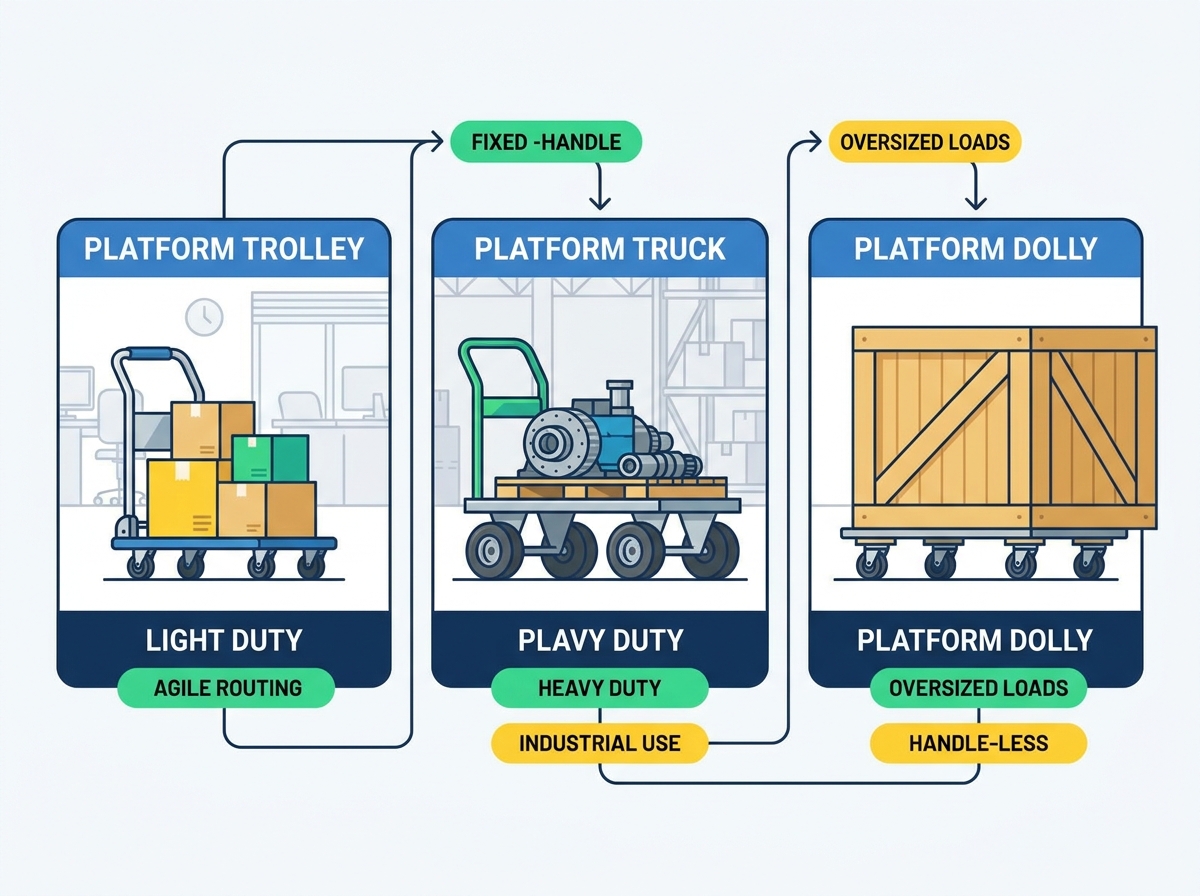
Comparing a platform trolley vs platform truck requires examining specific operational limits. Let us look at the light-duty trolley first. It serves commercial environments perfectly.
Typical specifications range from 300 lbs to 1,000 lbs in capacity. They usually feature aluminum or structural plastic decks. You will typically find 4-to-5-inch TPR (Thermoplastic Rubber) casters underneath them. These smaller casters keep the deck height low and accessible.
Best use cases include retail restocking and active office environments. They also excel in medical facilities and clean-room logistics. They maneuver easily in extremely tight aisles. Many feature foldable handles for quick storage.
Limitations exist, however. You cannot use them on rough outdoor terrain. They fail quickly under heavy manufacturing items dropped by forklifts. The lighter deck materials warp under localized heavy impacts.
Now consider the heavy-duty industrial truck. Typical specifications range from 1,000 lbs to well over 4,000 lbs. They rely on welded steel or heavy-duty hardwood decks. Wheels are much larger here. You will see 8-to-12-inch pneumatic or phenolic wheels.
Best use cases involve lumber yards and active manufacturing floors. They handle heavy warehouse distribution flawlessly. They transport industrial machinery and raw materials effectively. The rigid structure withstands severe daily abuse.
They do have inherent limitations. You must account for a significantly larger turning radius. A heavier tare weight requires more initial operator force to start moving. You cannot fold them up and hide them away.
Frame your final decision around the weight-to-effort ratio. Think about how much energy operators must expend. Match this directly against your specific facility payload demands. If you move light boxes frequently, choose agility. If you move steel blocks, choose structural rigidity.
Sometimes, upright handles simply get in the way. A platform dolly offers a flush, handle-less deck mounted on four casters. It provides a specialized, low-profile solution for awkward loads.
You should choose a dolly for moving oversized items safely. Think of large furniture pieces, wooden crates, and bulky appliances. A rigid handle would physically block these items from extending beyond the deck edge. Dollies allow the load to overhang safely on all four sides.
They also work perfectly when vertical space is restricted. You can slide them directly under low shelving between uses. They keep tools accessible without wasting valuable floor space in tight assembly zones.
You must balance these benefits against clear safety trade-offs. Operators do not have a handle to grip while moving. They must bend down or push directly against the load itself. This posture creates obvious ergonomic risks. We strongly recommend using dollies strictly for infrequent, bulky moves. Do not use them for continuous warehouse routing. Frequent bending leads to immediate operator strain. Keep their usage targeted and highly intentional.
Evaluating any material handling trolley requires a structured, logical framework. You must look far beyond simple weight capacity numbers printed on a box.
Understand payload and dynamic load ratings first. Static load capacity means the resting weight on the deck. Dynamic load capacity means the moving weight during transport. Never purchase equipment where average daily loads exceed 80% of the dynamic rating. This crucial buffer prevents premature caster failure and axle bending.
Caster selection dictates your operational success entirely. We consider it the absolute make-or-break factor in equipment selection.
Polyurethane/TPR: These perform exceptionally well on smooth concrete. They remain non-marking, reject floor debris, and roll quietly.
Pneumatic: These are essential for any outdoor applications. They absorb severe shocks over gravel and safely cross uneven doorways or thresholds.
Phenolic/Steel: These strictly handle maximum weight capacities. You must restrict their use to smooth, debris-free industrial floors to prevent damage.
Compare deck material durability next. Plastic resists corrosion perfectly and stays lightweight for operators. Steel handles massive capacities but rusts quickly if scratched deeply. Aluminum offers the absolute best weight-to-strength ratio, though it requires a higher upfront investment.
Caster Application and Performance Chart
Caster Material | Floor Compatibility | Shock Absorption | Load Capacity Range |
|---|---|---|---|
Thermoplastic Rubber (TPR) | Smooth Concrete, Tile, Linoleum | High | Light to Medium (Up to 1,000 lbs) |
Pneumatic (Air-filled) | Outdoor, Gravel, Uneven Asphalt | Maximum | Medium (Up to 2,000 lbs) |
Phenolic Resin | Smooth Industrial Concrete | Low | Heavy (Up to 4,000+ lbs) |
Forged Steel | Reinforced Concrete Only | None | Extreme (4,000+ lbs) |
You cannot ignore OSHA guidelines and ergonomic principles. Acceptable push and pull limits protect your workforce every single shift. Manual material handling requires strict physiological compliance. A heavily loaded truck carrying 2,000 lbs might demand two operators. This depends heavily on caster quality and actual floor friction.
You want to keep initial push forces well below safety limits. Heavy steel carts on small wheels require massive force to start moving. This initial burst of exertion causes most shoulder and lower back injuries. Always prioritize high-quality bearings to reduce this starting friction.
Facility floor wear presents another major operational risk. Wheel treads can ruin expensive epoxy floors in weeks. Rigid steel wheels easily crack unsealed concrete over time. They leave permanent grooves in softer surfaces. Always match wheel hardness directly to your specific floor surface. Softer floors demand softer wheels.
Consider storage and footprint carefully before buying. Folding-handle models save valuable space in small retail stockrooms. Rigid heavy-duty trucks require dedicated, painted parking zones. You must map out these parking areas before finalizing your purchase. Crowded aisles lead to immediate safety hazards and slowed forklift traffic.
How do you know which platform cart actually fits your operation? Follow this simple, three-step shortlisting logic to eliminate guesswork completely.
Step 1: Audit the Environment. Measure your narrowest aisles and tightest corners physically. Document floor conditions accurately. Note any ramps, thresholds, or outdoor transitions your team must cross daily.
Step 2: Define the Max Load. Identify the absolute heaviest item your team moves weekly. Calculate its dimensions and total weight. Add a 20% safety buffer to this number.
Step 3: Select the Category.
Choose a platform dolly for bulky, handle-obstructing items.
Choose a platform trolley for agile, sub-1,000 lb daily routing.
Choose a platform truck for relentless, heavy-duty industrial abuse.
Your actionable next step is highly straightforward. Request a sample unit from your supplier. Let your operators test it directly on the floor for a week. Consult a material handling specialist to verify your chosen caster configurations perform well under actual loads.
Relying on arbitrary product names alone invites guaranteed operational failure. True success lies in matching deck types, casters, and handle designs directly to your environment. You must evaluate the physical realities of your warehouse before making a choice.
The best equipment actively maximizes daily throughput. It moves goods faster while keeping operator fatigue strictly within ergonomic safety thresholds. Equipment should solve problems, not create new physical strains for your workforce.
Review your payload requirements thoroughly today. We encourage you to browse our specific catalog of material handling solutions. Contact our engineering and sales team to specify a customized unit designed precisely for your facility.
A: A hand truck uses an upright, two-wheel design relying on tilt and leverage. It moves tall, stacked boxes easily. A platform truck features a four-wheel flatbed design for maximum stability. It handles heavy, wide loads that require zero tilting.
A: Usually, you cannot. Pneumatic tires demand greater vertical clearance. Adding them to a standard trolley alters the load center of gravity drastically. It makes the unit top-heavy and compromises the original deck structure.
A: You must use high-grip friction pads on the deck corners. Always secure the load using ratchet strap tie-downs. Use proper loading techniques by centering the weight perfectly over the axles before pushing.
A: Industrial baselines typically start at 1,200 lbs for heavy-duty applications. Capacities scale rapidly up to 4,000 lbs or more. This requires reinforced steel decking and heavy-duty forged casters to maintain structural integrity.


