


Views: 0 Author: Site Editor Publish Time: 2026-02-22 Origin: Site


When people search “Industrial Casters,” there’s one important point to clarify from the start: industrial casters are not vehicle wheels. They are —the swivel or rigid caster assemblies mounted under carts, trolleys, racks, workstations, machines, and industrial equipment to make them movable, steerable, and safer to handle. In factories, warehouses, hospitals, and workshops, casters are the “hidden hardware” that quietly decides whether equipment moves smoothly or becomes a daily headache.
At Century Langyi casters & trolleys Mfg Co., Ltd., we work with customers who need reliable caster solutions for real working environments—heavy loads, uneven floors, high traffic, tight turning spaces, and strict safety requirements. In our experience, selecting industrial casters is not about choosing “the strongest wheel.” It’s about selecting the correct caster structure + wheel material + load rating + mounting method for your floor, your load, and your operating routine.
In this guide, we’ll explain what industrial casters are, how they work, the main types and components, how load ratings should be understood, what wheel materials mean in practice, and how to choose the right caster set for your equipment.
Industrial casters are used to make equipment:
mobile (move loads without forklifts for short distances)
steerable (turn and position equipment accurately)
stable (lock in place when required)
ergonomic (reduce pushing force and operator strain)
safe (reduce risk of slipping, tipping, or runaway carts)
Common applications include:
industrial trolleys and platform carts
warehouse racks and picking carts
tooling cabinets and mobile workbenches
manufacturing fixtures and assembly stations
medical equipment and laboratory carts
food processing and cleanroom equipment (with specific materials)
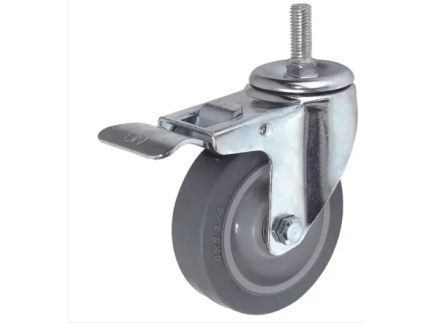
A caster is more than a “wheel.” It’s an assembly of components that must work together under load.
Wheel
The rolling element, made from materials such as polyurethane, rubber, nylon, or cast iron.
Fork (yoke)
The metal structure that holds the wheel and connects to the mounting plate or stem.
Swivel bearing (for swivel casters)
Allows the caster to rotate 360°, enabling tight turning and steering.
Axle and hardware
Connects the wheel to the fork and carries shear forces under load.
Brake or lock (optional but common)
Locks wheel rotation and/or swivel movement to keep equipment stable.
Understanding these parts helps buyers specify casters correctly—especially in heavy-duty environments.
Industrial casters are commonly grouped by how they move and how they mount.
Swivel casters rotate 360° and are used for steering and maneuverability. They are ideal for tight spaces, frequent turning, and carts that need to change direction often.
Rigid casters roll straight and do not swivel. They provide better directional stability and lower rolling resistance in straight-line travel.
Brakes improve safety by preventing movement. Some brakes lock only the wheel; others lock both the wheel and swivel.
For more control, total-lock prevents both rolling and swiveling; direction-lock can switch a swivel caster into straight-line mode for long-distance movement.
A “good caster cart” is not only about individual casters—it’s also about the set configuration.
Common configurations:
2 swivel + 2 rigid: stable for long straight paths, good for heavier carts
4 swivel: maximum maneuverability, best for tight indoor spaces
4 swivel (2 with brakes): common for workstations and equipment
6 casters: used for larger platforms to distribute load
Wheel material affects:
rolling resistance
floor protection
noise level
chemical resistance
load capacity
suitability for temperature environments
Wheel material | Best for | Key advantages | Typical tradeoffs |
Polyurethane (PU) | warehouses, factories | floor-friendly, quiet, durable | not ideal for extreme heat |
Rubber | hospitals, offices | very quiet, shock absorption | lower load capacity vs PU |
Nylon / PA | wet areas, chemicals | low rolling resistance, chemical resistance | noisy, can mark floors |
Cast iron / steel | heavy loads, harsh floors | very high load capacity | noisy, can damage floors |
Load rating is one of the most misunderstood specifications in industrial casters. Many buyers assume that if they choose four casters rated at “X kg each,” the total capacity is simply 4X. In real-world use, it rarely works that cleanly. Floors aren’t perfectly flat, loads aren’t always centered, and carts don’t move in smooth, laboratory-style conditions. If you size casters too close to the theoretical limit, you may see problems like harder pushing, faster bearing wear, flat spots, fork deformation, or even failure when the cart crosses a threshold or turns under load.
Total capacity is not evenly shared
In real environments, loads shift. A cart may rock slightly on uneven concrete, one wheel may hit a small bump, or the load may be placed off-center. In these cases, one caster can carry significantly more than its “expected” share. This is why a cart that seems within capacity can still overload a single caster during daily operation.
Use a safety factor
A common best practice is to size casters so the total rated capacity is higher than the equipment weight, not equal to it. This margin protects you from real-world variations—uneven floors, operator pushing force, minor impacts, and load placement differences. It also supports longer service life and more stable rolling performance.
Consider dynamic load, not just static weight
A caster’s job is not only to “hold weight.” It must survive motion events that increase stress beyond static load. Starting and stopping causes force shifts. Turning puts side load on forks and swivel bearings. Crossing thresholds creates short impacts. Even small drops or bumps multiply stress. For heavy carts, dynamic forces are often what cause early failures—not the static load.
When customers ask us for recommendations, we usually start with a few questions that quickly reveal what matters most.
Be sure to include:
equipment weight (the cart or machine itself)
maximum payload (what you’ll carry at peak)
dynamic forces (impacts, uneven ground, frequent starts/stops)
If the load changes day-to-day, size for the maximum realistic condition, not the average.
The floor decides rolling resistance, wear rate, and material choice. Consider:
smooth epoxy floor vs rough concrete
thresholds, slopes, cracks, expansion joints
wet/oily conditions that may require better traction and corrosion resistance
A wheel that performs well on epoxy may feel heavy and noisy on rough concrete.
Usage frequency changes the priority:
occasional movement → focus on durability, stability, and braking
frequent movement → rolling resistance, noise, and swivel performance become critical
If operators push it all day, small improvements in rolling resistance can reduce fatigue and improve efficiency.
Environment affects materials and bearing strategy:
temperature range
chemicals or cleaning agents
washdown requirements
static control needs (if any)
For example, washdown environments may need corrosion-resistant structures and materials that resist water absorption.
Mounting must match the structure and available space. Common types include:
top plate mount (stable and widely used)
threaded stem (common for lighter equipment)
grip ring stem (quick install in certain frames)
bolt hole mount (compact mounting design)
Choosing by load rating only
A high load rating does not guarantee smooth rolling on your floor or easy pushing.
Ignoring floor condition
Wrong wheel material can damage floors or increase pushing force.
Not planning brakes
Without brakes, equipment can drift, especially on slight slopes.
Underestimating turning stress
Swivel bearings and forks see high stress during turning under load.
So, what are industrial casters? They are—complete caster assemblies (wheel + fork + swivel/rigid structure + mounting) designed to move industrial equipment safely and efficiently. The right industrial casters improve maneuverability, reduce pushing force, protect floors, and increase stability with braking and locking options. Most problems happen when casters are chosen only by size or load rating, without considering floor conditions, usage frequency, and dynamic forces.
If you’re selecting industrial casters for carts, racks, or equipment and want practical recommendations based on your working conditions, you’re welcome to learn more from Century Langyi casters & trolleys Mfg Co., Ltd. We can help you choose the right caster type, wheel material, and configuration for smoother movement and longer service life.
Industrial casters are used to move and position equipment such as carts, trolleys, racks, workbenches, and machines safely and efficiently.
A wheel is only the rolling part. A caster is the full assembly (wheel + fork + swivel bearing or rigid frame + mounting and optional brake).
Do not divide by 4 for a 4-caster cart. Use a safety margin and consider uneven floors and dynamic forces, often dividing total load by 3 as a practical sizing rule.
Polyurethane is commonly chosen for concrete because it balances durability and floor protection, but the best choice depends on load, floor roughness, and noise requirements.


