


Views: 0 Author: Site Editor Publish Time: 2026-02-25 Origin: Site


When buyers search “wheels vs casters,” many are trying to solve a practical problem: How do I move equipment safely and smoothly in a factory, warehouse, hospital, or workshop? The confusion is understandable because both wheels and casters roll. But in industrial applications, the difference is not small—it affects steering, safety, load performance, floor protection, and how your equipment behaves under real working conditions.
Since we manufacture industrial casters for trolleys, carts, racks, and material-handling equipment, we want to clarify something early: a wheel is only the rolling part. A caster is a complete mobility unit that includes the wheel plus the mounting and (often) a swivel mechanism. If you choose the wrong one, the equipment may drift, vibrate, fail to track straight, or become difficult to control—especially under load.
A wheel is the round rolling component that rotates on an axle. By itself, a wheel does not define how a cart turns or how it mounts. It simply rolls.
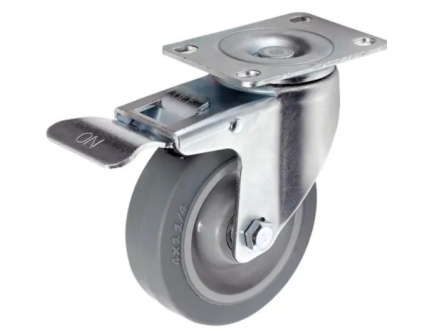
An industrial caster is an assembly that typically includes:
a wheel
a fork/yoke holding the wheel
a mounting method (top plate, bolt hole, stem, etc.)
optionally a swivel bearing (for turning)
optionally a brake/lock (for safety)
So the main difference is:
A wheel is a component; a caster is a system.
In factories and warehouses, mobility is not only about rolling—it’s about:
steering control in narrow aisles
stable tracking when moving straight
handling heavy loads safely
reducing operator effort
protecting floors
controlling vibration and noise
Casters are designed to solve these system-level requirements. A wheel alone usually cannot.
Industrial casters are usually categorized by how they turn:
A rigid caster rolls in a straight line and does not swivel.
Best for:
straight-line travel
long corridors
heavy loads needing stable tracking
Reality in use:
Fixed casters provide directional stability. They are often used in pairs with swivel casters so equipment can both track straight and still turn.
A swivel caster can rotate 360° around a vertical axis, allowing the equipment to change direction easily.
Best for:
tight turning spaces
frequent direction changes
maneuverability in crowded areas
Reality in use:
Swivel casters make turning easy, but at high speed or heavy load, they can shimmy if not correctly selected or if the floor is uneven.
This adds a locking mechanism. There are different brake styles:
wheel brake (stops wheel rotation)
swivel lock (stops swivel turning)
total lock (locks both)
Best for:
safety in loading/unloading
sloped floors
workstations that need stable positioning
Wheels are still used in industrial contexts, but usually where:
steering is handled by another mechanism (like an axle)
wheels are mounted directly to a frame
movement is mostly in one direction
there is a designed handle or control system
Common examples include:
hand trucks with axle-mounted wheels
some towable carts with axle assemblies
equipment where the wheel is part of a larger chassis design
In these systems, “turning” happens by lifting, pivoting, or steering through the frame—not by a caster swivel bearing.
Here’s a simple comparison:
Feature | Wheel | Industrial Caster |
What it is | Rolling component | Complete mobility assembly |
Steering | Depends on frame/axle design | Swivel or fixed steering built in |
Mounting | Axle / bracket | Plate / stem / bolt-hole mounts |
Safety options | Usually none | Brakes, directional locks |
Typical use | Axle-based carts, hand trucks | Trolleys, racks, workstations, carts |
Control in tight spaces | Limited | Excellent with swivels |
Industrial selection factors | mostly diameter + material | load + swivel + brake + material + mount |
Wheels are excellent for straight travel when mounted on an axle. But turning requires:
lifting one side
pivoting the frame
or using a steering handle system
This can be fine for a hand truck. It’s less ideal for workstations or racks that must move in tight factory lanes.
Casters are designed for industrial mobility where you need:
easy direction changes
controlled movement in tight spaces
flexible mounting on many products
This is why most industrial carts and trolleys use casters, not just wheels.
When specifying industrial casters, we recommend considering:
Always calculate load with a safety margin. In real life, floors aren’t perfect and loads shift. Many engineers also assume not all casters carry equal load at all times.
PU (polyurethane): quiet, floor-friendly, common for trolleys
Nylon: hard, durable, lower rolling resistance on smooth floors
Rubber: quiet, good grip, protects floor
Cast iron/steel: heavy-duty but can damage floors without protection
Larger wheels generally:
roll easier under load
handle gaps and debris better
reduce pushing effort
Common industrial setups:
2 swivel + 2 fixed: stable tracking + good turning
4 swivel: maximum maneuverability
all fixed: straight-line transport only
Choose based on how the equipment will be used:
wheel brake for stopping rolling
total lock for stable positioning
directional lock for straight-line control
Mounting must match your frame design and installation conditions.
Selecting the right caster setup for your equipment ensures efficiency, safety, and ease of movement. Here's a quick guide to common caster configurations for different industrial uses:
Equipment Type | Recommended Caster Setup | Why |
Warehouse trolley | 2 swivel + 2 fixed | Provides easy control and stable tracking, ideal for moving along straight paths and changing direction when needed. |
Mobile workbench | 4 swivel + total lock | Offers high maneuverability with precise steering, plus the ability to lock the wheels for stable parking. |
Heavy equipment base | Larger diameter + high-load fixed/swivel mix | Reduces pushing effort and improves stability under heavy loads, providing reliable performance in challenging environments. |
Hospital/clean carts | Quiet PU + precision swivel + total lock | Smooth, quiet movement suitable for hospital or cleanroom environments, with total lock for safe parking. |
Narrow aisle carts | Swivel + directional lock option | Ensures smooth straight-line control for narrow aisles, with a directional lock for stable travel along tight spaces. |
While selecting the right casters, it’s important to avoid these common mistakes:
Mistake 1: Buying wheels when you need steering
A wheel alone won’t allow steering unless the equipment has a proper axle or steering mechanism. Casters provide the necessary steering for easy mobility.
Mistake 2: Ignoring swivel performance under load
Small swivel casters can struggle with heavy loads, leading to difficulties in steering and potential instability. Larger, more robust casters are often needed for high-load applications.
Mistake 3: Underestimating brake importance
In many workplace settings, brakes are not just a convenience but a safety necessity to prevent unwanted movement, especially with heavy or high-value equipment.
Mistake 4: Choosing hard wheel material on sensitive floors
Hard wheel materials, like steel, can cause floor damage over time. For sensitive floors, softer materials like PU or rubber help minimize scratches and marks.
So, what is the difference between wheels and casters? In industrial mobility, the simplest answer is: a wheel is just the rolling part, while an industrial caster is a complete mobility unit that includes the wheel plus mounting, steering (fixed or swivel), and often braking. That “system difference” is why casters are used on most trolleys, racks, and industrial carts—they provide the control, safety, and flexibility that a wheel alone can’t deliver.
At Century Langyi casters & trolleys Mfg Co., Ltd., we focus on industrial caster solutions engineered for real working conditions: stable load handling, smooth rolling, reliable swivel performance, and practical brake options. If you’re selecting casters for a new trolley design or replacing worn units in a facility, you can learn more through Century Langyi casters & trolleys Mfg Co., Ltd. Our team can recommend suitable caster types, wheel materials, and mounting options based on your load, floor, and usage requirements—so your equipment moves smoothly and safely every day.
No. A wheel is one component. Industrial casters include the wheel plus the fork, mounting, and often swivel and brake systems.
For most industrial carts and trolleys, casters are better because they provide steering control, modular mounting, and brake options.
Common setups are 2 swivel + 2 fixed for stability and control, or 4 swivel for maximum maneuverability in tight spaces.
PU and rubber are popular because they protect floors and roll quietly. The best choice depends on load, floor type, and environment.


