


Views: 0 Author: Site Editor Publish Time: 2026-08-20 Origin: Site


Industrial operations rely heavily on seamless mobility. But standard equipment fails rapidly in extreme heat. When you push ordinary wheels into curing environments, the results are immediate and costly. Polyurethane treads melt into sticky puddles. Standard bearing grease bakes into hardened sludge. Thermal expansion causes wheel hubs to bind and seize completely.
These failures hit hard. In foundries, industrial bakeries, and curing processes, failed mobility leads to immobilized carts. It compromises worker safety. It abruptly halts active production lines. You cannot afford to extract jammed equipment from a 500-degree environment manually. Relying on basic replacements simply resets the clock until the next failure.
You need a targeted specification strategy. This guide helps you transition from reactive part replacements to engineered solutions. You will learn how to match the correct wheel material, bearing type, and high-temp lubrication to your exact thermal environment. Stop guessing and start specifying.
Temperature rating is not absolute: Always distinguish between continuous operating temperature and intermittent (peak) exposure when evaluating load limits.
Material dictates application: High-temp rubber suits bakery washdowns and floor protection up to 450°F; forged steel and cast iron are mandatory for 800°F+ foundry environments.
Bearings matter as much as wheels: High-temperature applications require specialized clearances for thermal expansion and extreme-pressure (EP) synthetic grease.
Floor conditions drive compromise: Specifying a heavy-duty industrial caster requires balancing thermal survival with floor preservation and ergonomic rolling resistance.
Specifying the wrong wheel for extreme environments triggers a cascade of mechanical failures. You must understand the exact failure modes to prevent them. When standard mobility equipment enters ovens, kilns, or autoclaves, several materials fail simultaneously. Standard polyurethane or nylon treads warp under sustained thermal loads. Eventually, they delaminate from the wheel core entirely. Meanwhile, extreme heat attacks the internal hardware. Standard zinc plating flakes off. Basic ball bearings lock up as metal expands without proper engineered clearances.
These mechanical failures introduce severe operational burdens. Buying an inadequate high-temperature caster guarantees frequent maintenance downtime. When a cart seizes inside an active oven, production stops. Maintenance teams must then perform hazardous manual extractions. Pulling a dead-weight cart from a 400°F enclosure risks severe burn injuries and ergonomic strain. The cycle of continuously replacing cheap, melted wheels creates massive labor inefficiencies.
To break this cycle, you must set strict success criteria for your equipment. A successful specification requires more than basic heat survival. It must deliver predictable, smooth rolling resistance under full load. You must demand zero structural degradation during continuous peak heat exposure. Finally, the chosen equipment must comply strictly with your facility's safety and ergonomic standards.
Common mistakes to avoid:
Assuming a "metal wheel" automatically survives high heat without checking the bearing grease limits.
Ignoring the thermal expansion rate of the caster fork, which can pinch and lock the wheel.
Failing to account for the cooling cycle, where rapid temperature drops can crack brittle materials.
Materials behave drastically differently as temperatures climb. You cannot rely on standard specification sheets here. Manufacturers normally rate standard load capacity at ambient room temperature (around 70°F). As heat increases, structural integrity drops. This is known as the derating principle. A wheel rated for 1,200 pounds at room temperature might safely hold only 400 pounds at 450°F. Buyers must always request high-heat load derating charts from manufacturers before making a purchase.
These non-metallic materials fill a critical gap in moderate-heat manufacturing. Specialized high-temp rubber and macerated phenolic resins utilize unique chemical blends. They resist melting at temperatures where standard plastics turn to liquid.
Best for: Commercial bakeries, medical autoclaves, and light industrial drying ovens.
Pros: They protect expensive epoxy or concrete floors. They provide significantly quieter operation than metal. They also resist degradation from mild washdown chemicals used in food sanitation.
Limitations: They cannot survive direct flame. Prolonged, continuous exposure above 500°F causes them to turn brittle, crack, and fail catastrophically.
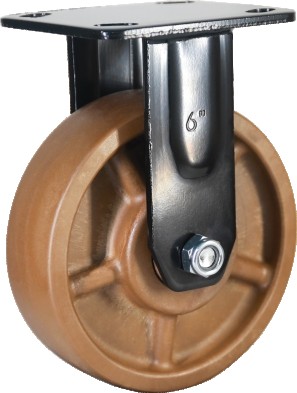
When you cross the 500°F threshold, organic materials and resins are no longer viable. You must transition to heavy metals. Cast iron offers excellent heat resistance, but forged steel provides superior tensile strength under extreme impact.
Best for: Foundries, heavy-duty curing kilns, and intense manufacturing processes.
Pros: They deliver absolute maximum structural integrity. Solid foundry caster wheels made of forged steel maintain heavy load capacities even during extreme continuous heat exposure.
Limitations: They are exceptionally harsh on facility flooring. They require perfectly smooth steel tracks or hardened concrete. Otherwise, they will cause severe floor grooving over time.
Material Selection Matrix for Extreme Temperatures | |||
Wheel Material | Max Temp (°F) | Floor Protection | Best Use Case |
|---|---|---|---|
High-Temp Rubber | ~400°F | Excellent | Bakery racks, hospital autoclaves |
High-Temp Phenolic | ~475°F | Good | Powder coating ovens, curing racks |
Cast Iron | ~800°F | Poor | Heavy manufacturing, kilns |
Forged Steel | ~1000°F+ | Poor | Foundry carts, extreme heavy loads |
Choosing the right equipment requires a holistic look at your operating environment. Temperature alone tells only half the story. You must weigh five specific criteria to ensure safe and reliable mobility.
Exposure Duration: You must accurately differentiate between peak and continuous heat. A 30-minute autoclave cycle allows the wheel core to remain relatively cool. However, a 12-hour continuous curing oven bake thoroughly heats every component to the ambient oven temperature. Long-duration bakes require much stricter material limits.
Load Capacity and Distribution: Heat drastically reduces weight limits. Calculate your total cart weight plus the maximum expected payload. Then, divide that number by three. We do this because industrial floors are rarely perfectly flat. Often, only three wheels bear the entire load at any given moment. Finally, adjust this calculated requirement against the manufacturer's thermal derating chart.
Floor Surface Compatibility: You must address the daily trade-off between heat resistance and floor protection. Forged steel survives the heat but acts like a grinding wheel on standard concrete. If steel damages your facility floor unacceptably, explore high-heat nylon or phenolic alternatives. Do this only if your continuous temperature limits safely allow it.
Environmental Contaminants: Heat rarely exists in a vacuum. Evaluate secondary threats actively attacking the wheel hubs. Foundry sand acts as a highly abrasive cutting agent against bearings. Baking grease causes debris buildup. High-pressure chemical washdowns strip away vital lubrication. You must specify appropriate seals or shields to block these contaminants.
Ergonomics & Push/Pull Force: Worker safety dictates push limits. A solid iron heavy-duty industrial caster increases initial rolling resistance significantly due to its massive weight. To mitigate worker strain and prevent injuries, specify larger wheel diameters. A larger wheel rolls much easier from a dead stop than a smaller one.
Many buyers focus entirely on the wheel tread. They forget the internal mechanisms entirely. This is a critical error. The internal bearings dictate whether the cart actually rolls or simply drags across the floor.
You must solve the thermal expansion problem. Metal naturally expands when exposed to high heat. Standard precision ball bearings feature very tight tolerances. When heated, the steel balls expand faster than the outer raceway. They will bind, score the raceway, and seize permanently. Properly engineered heat-resistant casters utilize specific internal clearances. These engineered gaps allow for the natural thermal expansion of the wheel hub, the axle, and the bearings without causing friction lock.
Selecting the right bearing involves balancing friction against survival. Two primary options dominate the extreme heat market.
Bronze/Sintered Plain Bearings: These are best for extreme heat environments where any grease would instantly vaporize. Sintered bronze contains microscopic pores holding residual lubrication. They create higher friction than ball bearings, making carts harder to push. However, they possess zero moving parts. They simply cannot seize under extreme thermal expansion.
High-Temp Roller Bearings: These are highly suitable for moderate heat applications. They work excellently as oven trolley wheels. Manufacturers engineer them with specific expansion gaps. They require dedicated high-heat grease to function safely.
Never use standard grease in an oven. Standard lithium grease liquefies completely at roughly 350°F. It drips onto the floor, creating a severe slip hazard, and leaves the bearing entirely dry. You must emphasize the strict necessity of specialized lubricants. Use graphite-based pastes, Teflon blends, or extreme-pressure (EP) synthetic high-temperature greases. Furthermore, implement a rigorous, high-frequency re-greasing maintenance schedule. Heat accelerates grease degradation. You must replenish it frequently to maintain mobility.
Do not order directly from a catalog without gathering facility data first. Proper specification requires empirical evidence and a methodical approach.
First, thoroughly audit the environment. Document the exact maximum temperature inside the oven. Record the continuous exposure time per cycle. Calculate the exact load weight. Document the floor type, including transitions over thresholds or grates. This data forms your baseline requirement.
Next, demand empirical data from your suppliers. Do not accept vague claims like "oven safe." Require the manufacturer to provide testing data for wheel material deformation points. Ask them to verify the exact bearing expansion tolerances used in their design. A reputable supplier will readily provide load-derating charts based on laboratory testing.
Finally, insist on pilot testing. Never roll out a completely new wheel specification facility-wide without proving it first. Purchase a single set of wheels. Install them on one oven trolley or foundry cart. Run this cart through your normal production cycles under actual thermal and weight loads. Inspect the treads and bearings after a week. If they survive without binding or degrading, you can confidently proceed with a facility-wide rollout.
Selecting reliable equipment for extreme heat is a precise engineering decision. It is not a standard procurement purchase. Standard hardware will fail, halt your production lines, and endanger your workforce. You must respect the physics of thermal expansion, material derating, and high-heat lubrication.
Your next step requires active data gathering. Consolidate your facility's exact weight, temperature duration, and environmental hazard data. With this information in hand, consult directly with a specialized manufacturer's engineering team. Request custom derating charts and specific bearing recommendations. By matching the exact material and mechanical tolerances to your unique environment, you secure long-term mobility and uninterrupted production.
A: It depends entirely on the material. High-temp rubber and phenolic resin max out around 400°F to 475°F. Cast iron and forged steel can withstand continuous temperatures exceeding 1000°F. However, load capacities drop significantly at these extreme temperatures. You must always consult thermal derating charts for precise limits.
A: Standard wheels seize due to thermal expansion and lubrication failure. Metal bearings expand in high heat. Without engineered expansion gaps, they lock together. Furthermore, standard lithium grease bakes off at 350°F, leaving bearings dry. You need specific high-temp tolerances and synthetic lubrication to prevent seizing.
A: High-temp rubber provides excellent floor protection but has a significantly lower load capacity than forged steel. Heat softens the rubber further, reducing its capacity. To handle heavy loads with rubber, buyers must significantly upsize the wheel diameter or increase the total quantity of wheels per cart.
A: Extreme heat bakes out even specialized grease rapidly. In high-use foundry environments, you may need to lubricate wheels weekly or even daily. If constant maintenance is impossible, switch to maintenance-free sintered bronze sleeve bearings, which eliminate the need for external grease entirely.


